Most car wash methods put paint at risk. Tunnel washes reuse brushes and cloth strips across thousands of vehicles, which can transfer grit that contributes to fine swirl marks most visible on dark paint in direct sunlight. Driveway bucket washes can have a similar effect if grit isn’t properly removed from the mitt between passes.
Rodeo Werkz spends days correcting exactly this kind of damage before applying ceramic coating, and that experience shaped our 14-Step Maintenance Detail: a system built around removing as much contamination as possible before anything makes contact with your paint.
This is a maintenance detail, not a basic wash and not a full paint-correction or deep-interior package. It’s the same preparation process we use before ceramic coating and PPF work, offered on its own as an ongoing maintenance service for premium paint, PPF, ceramic coating, and window tint.
Built by Jasper Zhang: The Rodeo Werkz Standards System
Rodeo Werkz founder Jasper Zhang developed a proprietary, repeatable, and auditable automotive film installation standards system based on his hands-on installation experience across North America. Designed to serve as an important reference for premium automotive film installation in Dallas, the system includes the 18-Step Precision PPF Installation Standard, the 13-Step Window Tint Installation Standard, and the 6-Step Ceramic Coating System. Each standard breaks the installation process into clearly defined, inspectable stages, helping reduce quality variations caused by individual habits and inconsistent techniques while producing more stable and precise results.
Our goal is not simply to complete one installation, it is to help move the automotive film industry from relying solely on individual experience toward documented processes and measurable quality standards. The 14-Step Maintenance Detail applies that same standards-based approach to the service that protects those installations day to day. 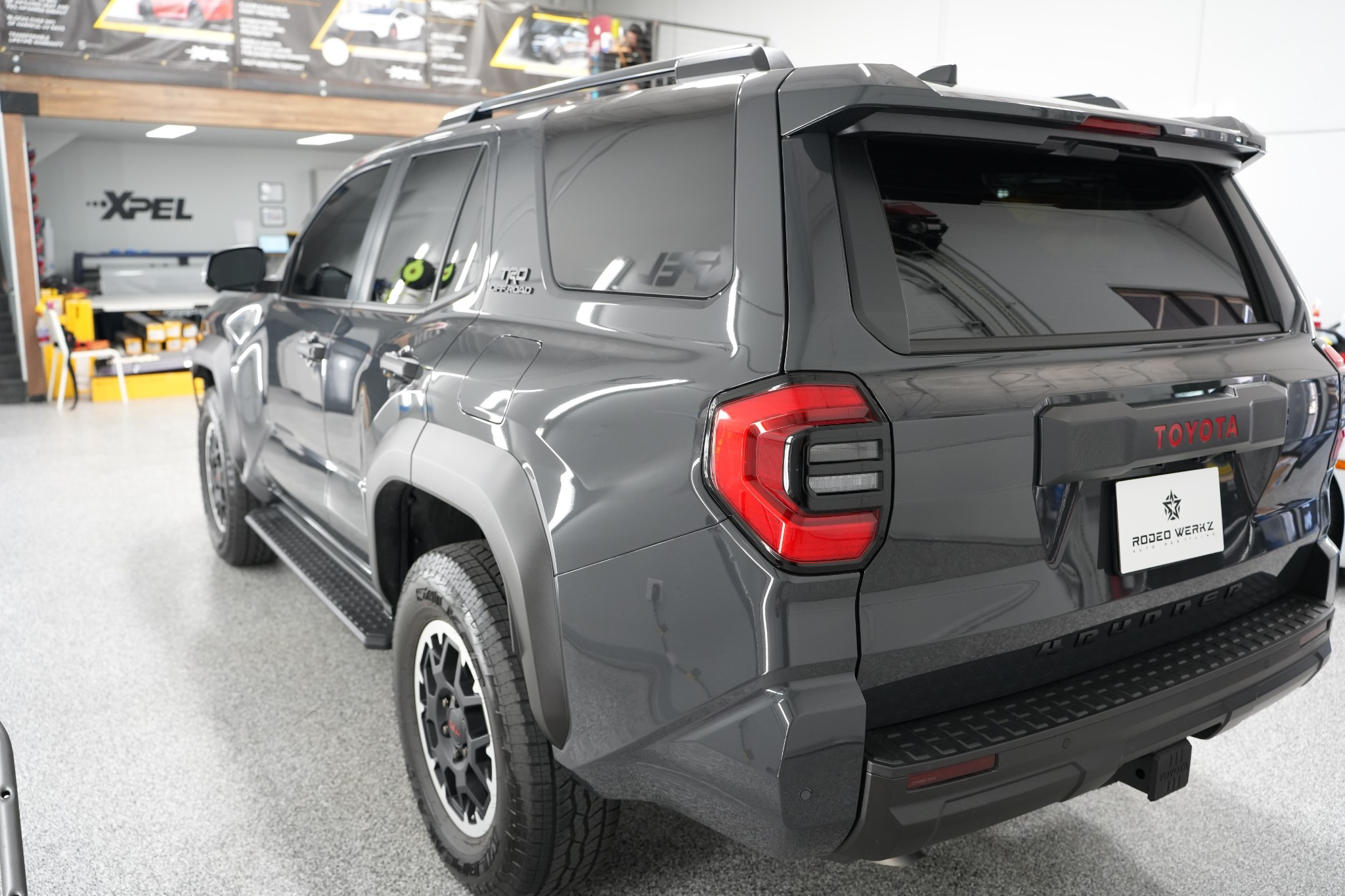
What Stands Behind the Rodeo Werkz 14-Step Maintenance Detail
- Built by a team that performs paint correction daily, using BigFoot polisher systems, so the detail process is designed around what actually causes marring.
- No brush contact — hand application throughout, using tools selected to help reduce the risk of wash-induced marring.
- Compatible with properly maintained PPF, ceramic coating, and window tint, using products and methods selected for those surfaces.
- A climate-controlled, dust-managed facility.
- Controlled rinse parameters — pressure, nozzle angle, working distance, and water flow are managed around trim, seals, badges, and PPF edges.
- Premium chemistry, including nano ceramic shampoo formulated to be compatible with existing coatings and sealants.
- Extensive experience across North Texas, from daily drivers to exotics.
- One roof, one standard — maintenance detailing, ceramic coating, PPF, window tint, and vinyl wraps delivered by the same team.
The Rodeo Werkz 14-Step Maintenance Detail
Phase One: Preparation Before Hand Contact (Steps 1–3)
Three preparation stages are completed before the hand-contact wash begins, aimed at removing as much contamination as possible before a mitt or towel ever touches the paint.
Step 1: Targeted Pre-Treatment for Bugs, Road Film, and Bonded Contaminants
Bug remover, iron remover, and other decontamination products are selected and applied according to the vehicle’s actual condition, not automatically on every visit. Bug residue is acidic and can etch clearcoat if left to sit; iron remover breaks down embedded brake dust and rail dust particles bonded into the finish so they rinse away rather than being dragged across the paint later in the process.
Step 2: Dedicated Wheel Cleaning
Wheels are cleaned using dedicated chemicals, tools, buckets, and towels kept separate from anything used on paint, addressing brake dust and brake-dust staining before the body is washed. This is a separation of materials for cleanliness and consistency, not a claim that other sequencing automatically contaminates paint.
Step 3: Nano Ceramic Shampoo
Shampoo is applied to lubricate the surface ahead of hand contact and to clean without disrupting properly maintained protection. It’s formulated to be compatible with PPF, ceramic coatings, sealants, and wax, though heavily degraded or improperly maintained coatings may respond differently.
Phase Two: The Contact Wash (Steps 4–5)
Step 4: Wool Mitt Hand Wash
Contact happens by hand, panel by panel, using a wool mitt selected for its ability to lift and hold contamination away from the surface. This approach, combined with the preparation in Phase One, helps reduce the risk of wash-induced marring — no wash method can guarantee zero risk of marring.
Step 5: Controlled Rinse
Rinse pressure, nozzle angle, working distance, and water flow are all managed around trim, seals, badges, and PPF edges. Uncontrolled high-pressure water at close range can lift trim, force water past seals, and catch PPF edges, so our rinse parameters are set specifically to avoid that outcome rather than relying on pressure alone as a safety standard.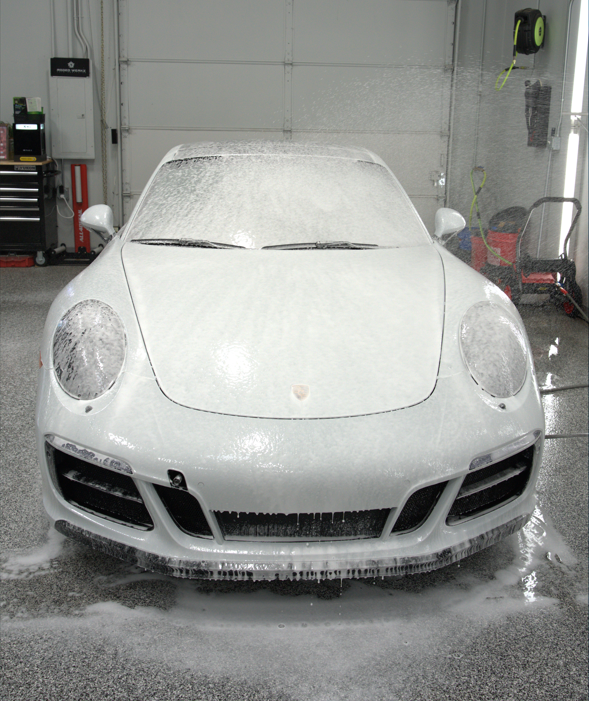
Phase Three: Low-Contact Drying (Steps 6–7)
Step 6: Professional Drying Towels
Plush, clean drying towels are used to lift water with minimal pressure rather than dragging it across the finish. Towels are never reused after touching the ground.
Step 7: Controlled Air for Crevices and Door Jambs
Controlled, clean air is used to remove trapped water from mirror housings, badge recesses, grille slats, panel gaps, trim edges, wheel faces, and door jambs — areas prone to water spotting if left damp, and areas a towel can’t safely reach without added contact risk.
Phase Four: Glass, Wheels, and Tires (Steps 8–10)
Step 8: Tint-Safe Glass Cleaning
We use tint-safe, ammonia-free glass cleaner to avoid chemicals that may affect certain aftermarket window films over time.
Step 9: Wheel Detail Pass
A finishing pass on barrel faces, spoke edges, lug recesses, and areas around calipers where brake dust concentrates.
Step 10: Tire Finish
Tire dressing is applied evenly by hand. Dressing restores an even, conditioned finish and may help protect against environmental exposure; it is not a guarantee against browning or cracking over time. 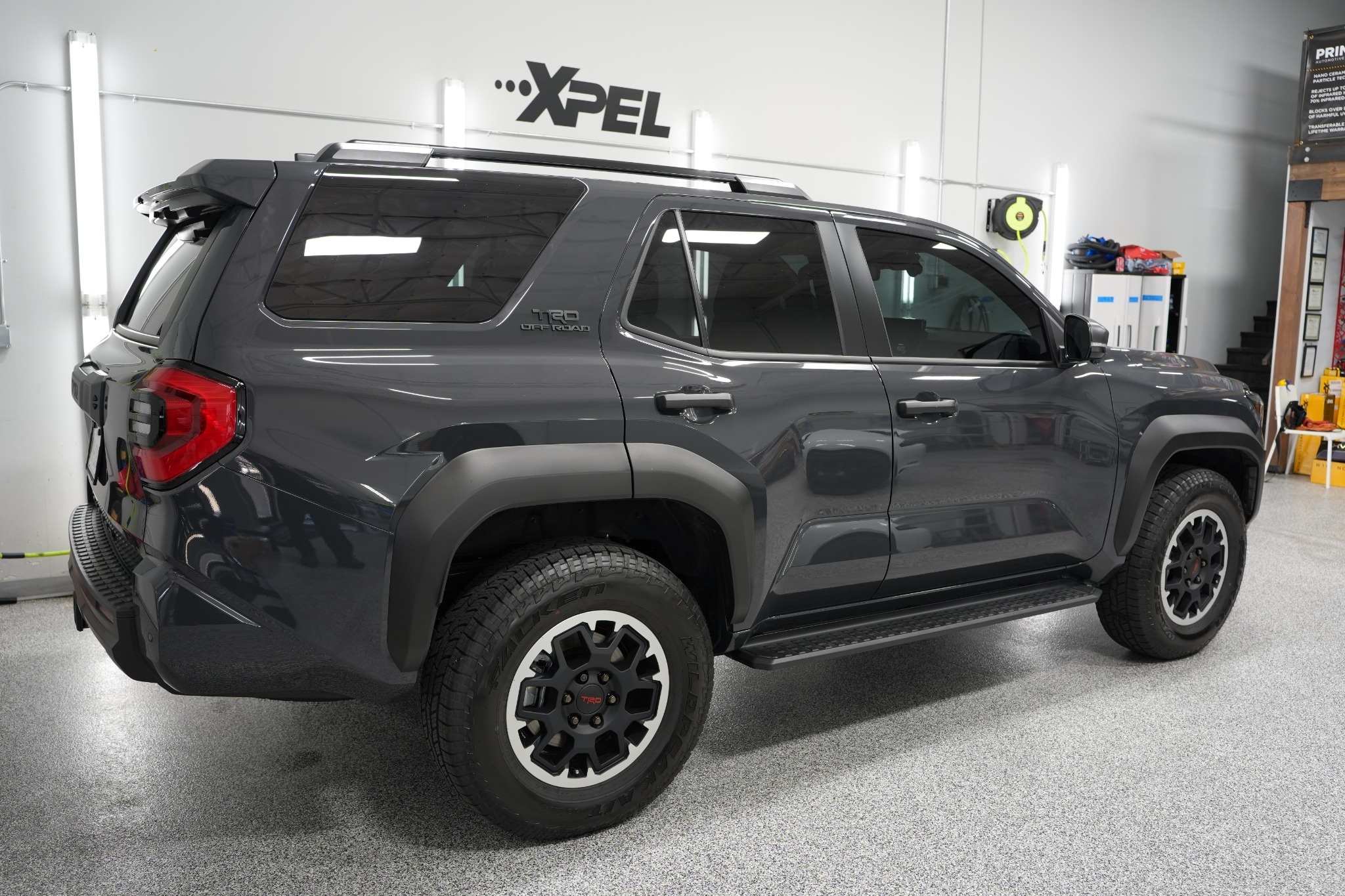
Phase Five: Interior and Final Inspection (Steps 11–14)
Step 11: Interior Air Cleaning
Controlled air is used to dislodge dust and debris from seat rail channels, seam gaps, vent louvers, and console seams before vacuuming.
Step 12: Vacuum
Full interior vacuum — carpets, mats, seats, seat rails, and trunk.
Step 13: Surface-Appropriate Finishing Product
A finishing product is selected based on the vehicle’s surface — bare paint, PPF, ceramic coating, or satin finish rather than applying the same gloss-enhancing detail spray to every surface.
Step 14: Final Inspection
Every panel, piece of glass, wheel, and interior surface is inspected under dedicated lighting before your vehicle is returned.
Interior service scope: this package includes controlled air cleaning and vacuuming. Deep cleaning, shampoo extraction, leather treatment, and stain removal are available separately.
Who This Maintenance Detail Is Built For
- Ceramic-coated vehicles — proper detailing supports coating performance, though XPEL’s warranty coverage remains subject to maintenance and the required annual inspection schedule, regardless of how the vehicle is washed.
- PPF-protected vehicles — controlled rinse parameters are specifically set to reduce the risk of catching or lifting film edges.
- Tinted vehicles — ammonia-free glass cleaner avoids chemistry that can affect certain films over time.
- Dark or premium paint — where marring is most visible.
- Owners maintaining cosmetic condition — regular professional detailing helps preserve a vehicle’s cosmetic condition and may improve its presentation to future buyers; it does not guarantee a specific increase in resale value.
Why Dallas Drivers Choose Rodeo Werkz for Detailing
When comparing detailing providers, it’s worth asking:
- Does anything mechanical (brushes, spinning pads) contact the paint?
- What preparation happens before hand contact begins?
- How is rinse pressure and technique controlled around trim, seals, and PPF edges?
- Is the shampoo formulated to be compatible with ceramic coating and sealants?
- Is glass cleaner ammonia-free and safe for tinted windows?
Rodeo Werkz built its 14-Step Maintenance Detail around clear answers to each of these, and serves drivers across Dallas, Plano, Frisco, McKinney, Prosper, Celina, Richardson, Addison, The Colony, Southlake, Trophy Club, and Grapevine.
Frequently Asked Questions
What makes Rodeo Werkz’s maintenance detail different?
A documented 14-step system developed by a team that performs paint correction daily, hand washing rather than brush contact, controlled rinse parameters designed around trim and PPF edges, and chemistry selected for compatibility with ceramic coating and window tint.
Are automatic car washes bad for my paint?
Tunnel washes with spinning brushes or cloth strips carry contamination between vehicles, which is a common contributor to fine swirl marks, especially visible on dark paint. Touchless automatic washes avoid physical contact but often rely on stronger chemicals that can shorten the life of coatings, sealants, and wax over repeated use.
Can I take my ceramic-coated car through a regular car wash?
You can, though harsh detergents and brush contact are two of the more common factors that shorten coating performance and reintroduce marring. A maintenance detail matched to your coating is one way to help protect that investment, alongside keeping up with XPEL’s required inspection schedule.
Is this detail safe for a car with paint protection film?
Our process is built around PPF-safe handling — controlled rinse parameters, hand contact rather than mechanical brushes, and no assumptions that any single pressure number is inherently “safe” regardless of technique.
How often should I get a maintenance detail in Dallas?
Roughly every two weeks works well for most North Texas drivers, sooner after heavy bug exposure, tree sap, or construction dust — bug residue and bird droppings are acidic and shouldn’t sit on the paint.
How long does a Rodeo Werkz maintenance detail take?
Longer than a tunnel wash, since 14 steps are performed by hand across the exterior, wheels, glass, and interior. We’ll give you an accurate window when you book.
I just had my windows tinted. When can I get a maintenance detail?
Give your tint a few days to cure before interior glass cleaning; we’ll confirm an exact timeframe at handoff. Exterior detailing is generally fine sooner, since tint is applied to the interior surface of the glass.